AI-Powered Hospital Design in 2026: Building Smarter, Safer, and More Efficient Healthcare Facilities
Artificial Intelligence (AI) is reshaping nearly every industry, and healthcare infrastructure is no exception. In 2026, hospital design is no longer limited to architectural layouts and construction plans. Instead, hospitals are being designed with intelligent technologies that improve patient care, optimize operations, reduce costs, and prepare healthcare facilities for future challenges.
From predictive space planning to automated building management systems, AI-powered hospital design is helping healthcare providers create smarter, more efficient environments. Hospitals that integrate AI into their planning and infrastructure can deliver better patient outcomes while improving operational efficiency and sustainability.
Whether you’re planning a new healthcare facility or upgrading an existing one, adopting AI-driven design principles is becoming essential for long-term success. At Hospitals Infra, we help healthcare organizations develop future-ready infrastructure through intelligent planning, modern engineering, and innovative healthcare solutions.
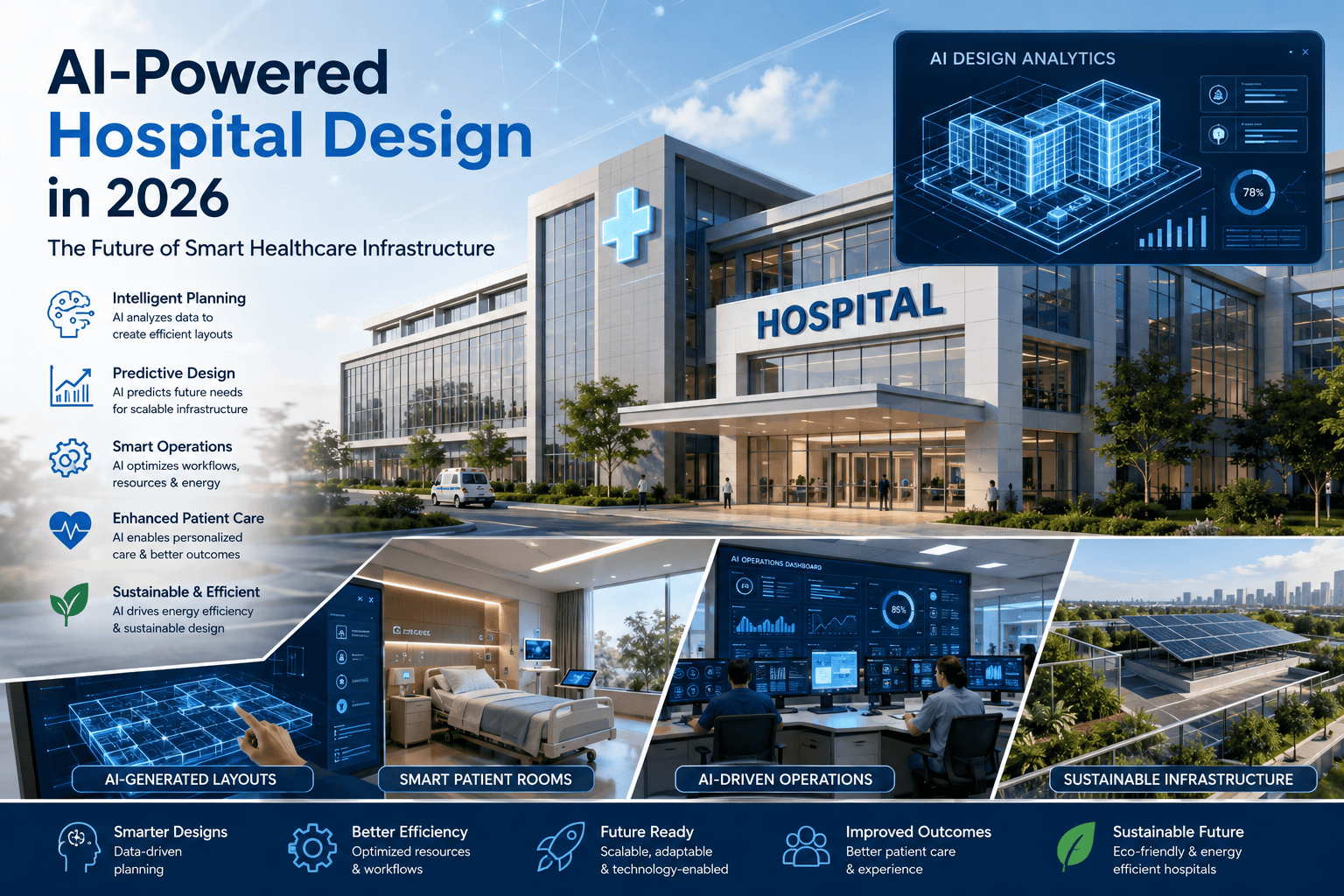
Why AI-Powered Hospital Design Matters
Artificial Intelligence enables hospitals to make data-driven planning decisions, optimize patient flow, reduce operational costs, improve energy efficiency, enhance infection control, and build healthcare facilities that are ready for future medical technologies.
Why AI Matters in Modern Hospital Design
Healthcare facilities generate enormous amounts of operational and clinical data every day. Artificial Intelligence analyzes this information to help architects, engineers, consultants, and hospital administrators make informed decisions throughout the planning and construction process.
Unlike traditional planning methods, AI enables predictive analysis, real-time simulations, and intelligent optimization that reduce design errors while improving hospital efficiency and patient outcomes.
AI Helps Hospitals Become:
- More patient-centric healthcare facilities
- Operationally efficient hospitals
- Energy-efficient and sustainable buildings
- Easier to maintain and upgrade
- Better prepared for emergency situations
- Scalable for future healthcare demands
Learn more about our Hospital Planning, Hospital Architecture, and Healthcare Interior Design services for designing intelligent healthcare facilities.
Key Applications of AI in Hospital Design
Artificial Intelligence is transforming every stage of hospital infrastructure development—from architectural planning and engineering to facility management and clinical workflows. AI-powered technologies allow healthcare organizations to design hospitals that are safer, smarter, and more efficient than ever before.
1. Intelligent Space Planning
AI analyzes patient flow, staff movement, equipment usage, and departmental interactions to recommend the most efficient hospital layouts. Instead of relying solely on manual planning, AI can simulate thousands of design possibilities before construction begins.
Benefits of Intelligent Space Planning
- Reduced patient waiting times
- Improved emergency department efficiency
- Better departmental connectivity
- Faster staff movement
- Enhanced patient experience
- Optimized use of hospital space
Hospitals can significantly improve operational performance by integrating AI with professional Turnkey Hospital Projects that combine architecture, engineering, and healthcare planning into a unified solution.
2. Predictive Patient Flow Analysis
Patient congestion can negatively impact healthcare quality and operational efficiency. AI predicts patient volumes, emergency admissions, outpatient demand, bed occupancy, and ICU utilization by analyzing historical and real-time data.
These predictive insights allow planners to design hospitals capable of handling future patient loads without overcrowding while improving the overall patient experience.
AI Can Predict:
- Peak patient volumes
- Emergency admissions
- Outpatient department demand
- Bed occupancy trends
- ICU utilization rates
- Future healthcare capacity requirements
Explore our specialized ICU Planning and Medical Equipment Planning solutions to create efficient critical care environments.
3. Smart Building Management Systems (BMS)
Modern hospitals rely on AI-powered Building Management Systems (BMS) to automate and monitor critical infrastructure, including lighting, HVAC systems, temperature control, air quality, water management, energy consumption, and security systems. These intelligent systems improve operational efficiency while reducing maintenance costs and energy usage.
AI-Powered Building Management Controls
- Smart lighting automation
- Intelligent HVAC control
- Real-time temperature monitoring
- Indoor air quality management
- Water consumption optimization
- Energy usage analytics
- Integrated security monitoring
Hospitals implementing AI-driven building management benefit from lower operational costs, improved sustainability, and enhanced patient comfort while ensuring compliance with modern healthcare infrastructure standards.
4. AI-Driven Energy Optimization
Hospitals operate around the clock, making energy management one of the largest operational expenses. Artificial Intelligence continuously monitors electricity usage and automatically adjusts lighting, ventilation, cooling systems, and backup power equipment to maximize efficiency without affecting patient care.
Benefits of AI Energy Management
- Lower electricity costs
- Reduced carbon emissions
- Improved HVAC efficiency
- Smart power distribution
- Sustainable hospital operations
- Reduced maintenance costs
Healthcare organizations aiming for sustainable infrastructure can combine AI with intelligent hospital planning and environmentally responsible healthcare architecture to build future-ready facilities.
5. Smart ICU and Operation Theatre Planning
Critical care departments require highly optimized layouts to improve clinical workflows and patient safety. AI helps planners determine the best positioning of equipment, medical gas outlets, staff movement paths, infection-control zones, and emergency response routes.
Through predictive simulations, hospitals can create intensive care units and operation theatres that improve efficiency while supporting better patient outcomes.
AI Optimizes:
- Equipment positioning
- Clinical workflow planning
- Emergency response routes
- Infection control zoning
- Medical Gas Pipeline planning
- Space utilization
Discover our advanced Modular Operation Theatre solutions designed to support world-class surgical environments and improve operational performance.
6. Predictive Maintenance
Unexpected equipment failures can disrupt hospital operations and affect patient care. AI continuously monitors equipment performance and predicts maintenance requirements before breakdowns occur, helping hospitals minimize downtime and extend the life of critical infrastructure.
AI Predicts Maintenance For:
- HVAC systems
- Medical equipment
- Electrical infrastructure
- Elevators
- Oxygen plants
- Backup power systems
Predictive maintenance improves equipment reliability, reduces emergency repair costs, and ensures uninterrupted healthcare services for patients and medical professionals.
Why Hospitals Are Investing in AI
Artificial Intelligence is enabling hospitals to reduce operational costs, improve patient safety, optimize clinical workflows, strengthen infection prevention strategies, and create intelligent healthcare facilities that are prepared for the future of modern medicine.
Benefits of AI-Powered Hospital Design
Hospitals that integrate Artificial Intelligence into their planning and infrastructure benefit from smarter operations, improved patient care, enhanced sustainability, and long-term cost savings. AI supports healthcare organizations by making hospital environments more efficient, adaptive, and future-ready.
Key Benefits
- Faster and more accurate hospital planning
- Better space utilization and departmental connectivity
- Improved patient satisfaction and experience
- Enhanced clinical workflows
- Reduced operational and maintenance costs
- Higher energy efficiency and sustainability
- Improved infection prevention strategies
- Increased staff productivity
- Future-ready healthcare infrastructure
- Higher long-term return on investment (ROI)
Healthcare providers adopting AI-driven planning can deliver safer healthcare services while improving operational excellence across every department.
Why Hospitals Are Adopting AI
Artificial Intelligence empowers healthcare organizations to design intelligent hospitals that improve patient safety, optimize workflows, reduce operating costs, and support long-term sustainability through data-driven decision-making.
Challenges in Implementing AI-Powered Hospital Design
Although Artificial Intelligence offers significant advantages, successful implementation requires strategic planning, skilled professionals, and proper infrastructure. Healthcare organizations must address both technological and operational challenges before adopting AI-driven systems.
Common Challenges
- High initial investment costs
- Integration with legacy hospital systems
- Cybersecurity and data privacy concerns
- Availability of skilled AI professionals
- Regulatory compliance requirements
- Technology adoption and staff training
- Ongoing software updates and maintenance
Working with experienced healthcare infrastructure consultants helps hospitals overcome these challenges while ensuring successful implementation and long-term operational efficiency.
Future Trends in AI Hospital Design
Artificial Intelligence continues to evolve rapidly, and future hospitals will become increasingly autonomous, connected, and intelligent. Hospitals being designed today must be flexible enough to accommodate tomorrow’s healthcare technologies.
Emerging AI Trends
- Autonomous hospital operations
- AI-assisted architectural planning
- Robotics integration
- Smart patient rooms
- Predictive emergency response systems
- Voice-controlled healthcare environments
- AI-powered diagnostic support
- Real-time occupancy analytics
- IoT-enabled healthcare infrastructure
- Cloud-based hospital management systems
Future-ready hospitals will combine Artificial Intelligence, IoT, automation, robotics, and predictive analytics to create safer, more responsive healthcare environments capable of meeting growing patient demands.
Why Choose Professional Healthcare Infrastructure Consultants?
Designing an AI-powered hospital requires expertise across healthcare architecture, engineering, clinical workflows, medical technology integration, infection control, and regulatory compliance. Professional consultants ensure every aspect of the project aligns with modern healthcare standards and future operational requirements.
Hospitals Infra Provides Expertise In:
- Hospital Planning
- Hospital Architecture
- Healthcare Interior Design
- Modular Operation Theatre Solutions
- ICU Planning
- Medical Equipment Planning
- Turnkey Hospital Projects
Our multidisciplinary team helps healthcare organizations develop intelligent, efficient, and future-ready hospitals by combining innovative technologies with world-class healthcare infrastructure planning.
Expert Insight
The hospitals of tomorrow will rely on Artificial Intelligence to improve operational efficiency, enhance patient outcomes, strengthen sustainability, and deliver smarter healthcare experiences. Investing in AI-powered hospital design today prepares healthcare organizations for the evolving demands of modern medicine.
Frequently Asked Questions
Find answers to the most common questions about AI-powered hospital design, healthcare infrastructure, and smart hospital planning.
AI-powered hospital design uses Artificial Intelligence to optimize hospital planning, architecture, workflows, energy management, infection control, and operational efficiency to create smarter and future-ready healthcare facilities.
AI improves hospital infrastructure by optimizing space utilization, patient flow, energy efficiency, predictive maintenance, infection prevention, and clinical workflows while reducing operational costs.
Yes. AI solutions can be scaled for hospitals of all sizes, helping improve operational efficiency, patient care, resource management, and long-term sustainability.
Modern AI-powered hospitals use Machine Learning, IoT sensors, Digital Twins, Building Management Systems (BMS), predictive analytics, robotics, smart automation, and cloud-based monitoring platforms.
Yes. AI continuously optimizes energy usage, water consumption, HVAC performance, waste management, and carbon emissions, supporting sustainable and environmentally responsible healthcare infrastructure.
Hospitals Infra provides end-to-end healthcare infrastructure solutions including Hospital Planning, Hospital Architecture, Modular Operation Theatres, ICU Planning, Medical Equipment Planning, Healthcare Interior Design, and Turnkey Hospital Projects.
Build the Future of Healthcare with AI-Powered Hospital Design
Hospitals Infra specializes in intelligent Hospital Planning, Hospital Architecture, Healthcare Interior Design, Modular Operation Theatres, ICU Planning, Medical Equipment Planning, and complete Turnkey Hospital Projects tailored for future-ready healthcare facilities.
Helpful Resources
Conclusion
AI-powered hospital design is transforming healthcare infrastructure by creating smarter, safer, and more efficient hospitals. From intelligent space planning and predictive maintenance to sustainable building management and advanced infection control, Artificial Intelligence enables healthcare organizations to deliver better patient care while improving long-term operational efficiency.
Whether you are developing a new healthcare facility or upgrading an existing hospital, partnering with Hospitals Infra ensures access to industry-leading expertise in AI-enabled hospital planning and future-ready healthcare infrastructure solutions. Contact us today to discuss your next healthcare project.